Liquidity Sweep method
Above old highs and below old lows sit many stop orders and breakout orders: liquidity. Price often runs through such a level, triggers those orders and then turns around. The Liquidity Sweep method marks these levels and trades the turn.
- A high level (resistance) gives SELL signals.
- A low level (support) gives BUY signals.
- Open-hour levels work both ways (see below).
Where the levels come from
Turn on any combination:
| Source | The level |
|---|---|
| Swings | Swing highs and lows on the swing timeframe (a high with Swing Strength lower candles on each side) that price has not traded through since. The newest Max Active Swings per Side per side are kept. |
| Previous day / week | PDH / PDL: high and low of the last trading day. PWH / PWL: of the last week. |
| Sessions | High and low of the Asia, London, New York or NY lunch window. Drawn live while the window runs; tradeable once it ends. |
| Custom range | High and low of your own time window, with your own label. |
| Custom levels | Prices you type in, for example a round number or a level from your own analysis. |
| Open-hour levels | The opening price at times you choose, for example 09:30 New York. |
| Rejection blocks | A candle on a block timeframe whose wick swept the previous candle's high or low and closed back, confirmed by a fair value gap. The middle of the wick is the level. Up to three timeframes (RB: Timeframe 1, RB: Use Timeframe 2?, RB: Use Timeframe 3?), each with its own blocks. |
| Order blocks | The last opposite candle before a strong move that leaves a fair value gap, on up to three timeframes. The middle of its body, the Mean Threshold, is the level. See Order Blocks. |
Session, range and open-hour times follow Time Zone of All Time Inputs (OTHER SETTINGS).
Example: swing levels
Swing highs and lows as FCC_EA draws them.
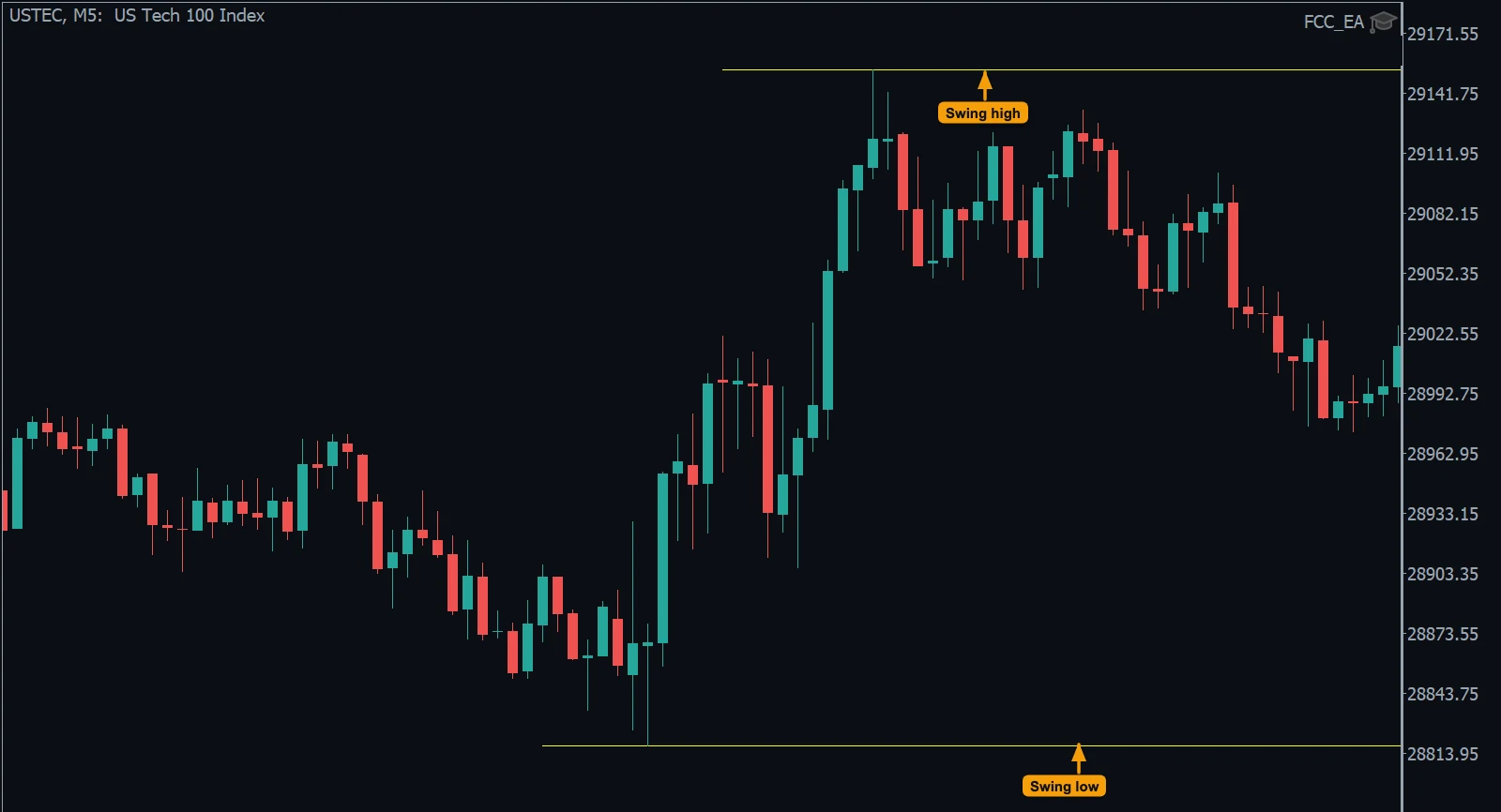
- A swing high: a high with lower candles on each side (Swing Strength) that price has not traded through since.
- A swing low: the same below price.
Example: rejection block
A rejection block and the level it trades.
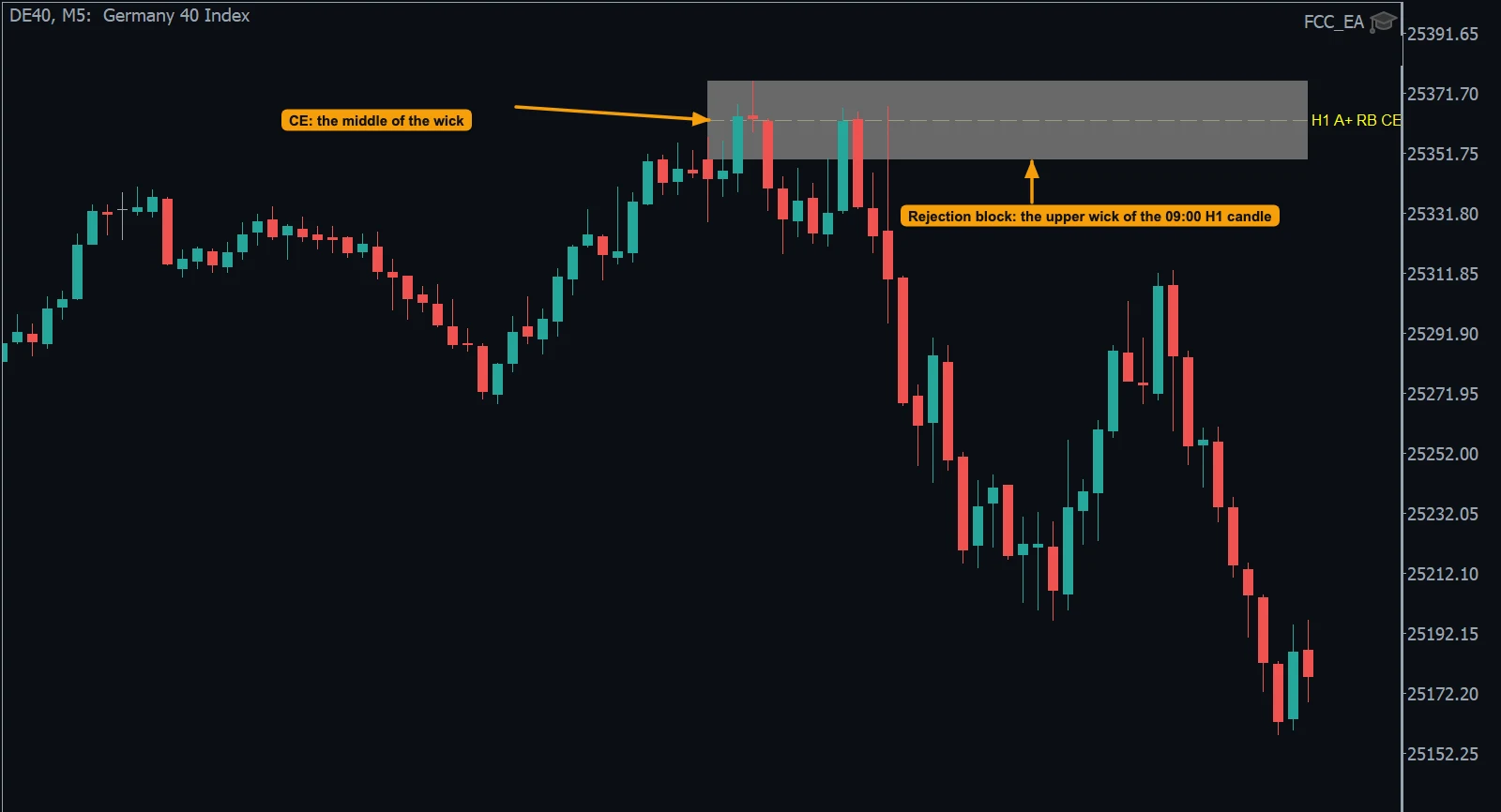
- A rejection block: the wick of an H1 candle that swept the candle before it and closed back (grey box). Price turned down from it.
- The traded level is the CE, the middle of the wick (dashed line).
With RB: Use Timeframe 2? and RB: Use Timeframe 3? rejection blocks are found on up to three timeframes at once, for example H1 and H4. Each timeframe keeps its own blocks and its own limit (RB: Max Active Levels per Timeframe (oldest removed, 0=unlimited)), and the label shows the block's timeframe.
Example: order block
An order block is traded at its Mean Threshold (MT), the middle of the candle body, labelled for example H1 OB MT. How FCC_EA finds order blocks, the timeframes, the retire rules and a step-by-step setup: Order Blocks.
Example: an open-hour level
The opening price of the 10:00 candle (New York time) as a level, traded on the retest.
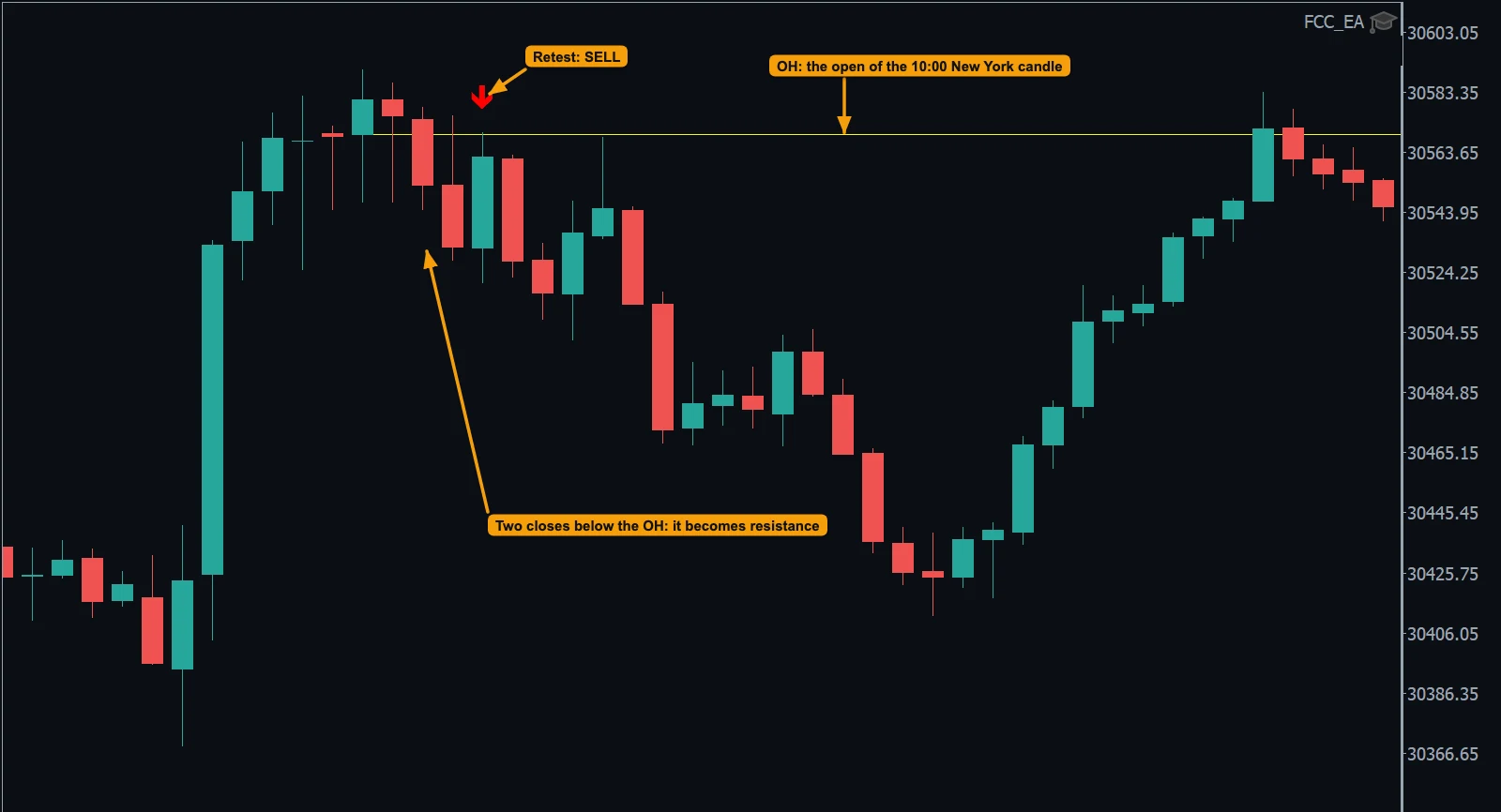
- OH: the opening price of the 10:00 candle, New York time (Open-Hour Times 10:00, Time Zone of All Time Inputs New York).
- After Open-Hour Warm-Up, two candles close below it (Open-Hour: Closed Bars to Set / Flip Side 2): the level becomes a resistance.
- Price comes back up to it: SELL (Touch trigger). Price then fell about 150 points.
Triggers
Reclaim (default)
- Sweep: price goes beyond the level (a wick is enough). The level is now armed: an armed high turns red, an armed low green.
- Reclaim: a candle of the Signal Timeframe closes back on the original side of the level: signal.
Example: the previous day's low (PDL) is 5800. Price drops to 5795, the PDL turns green. Two candles later one closes at 5803: BUY.
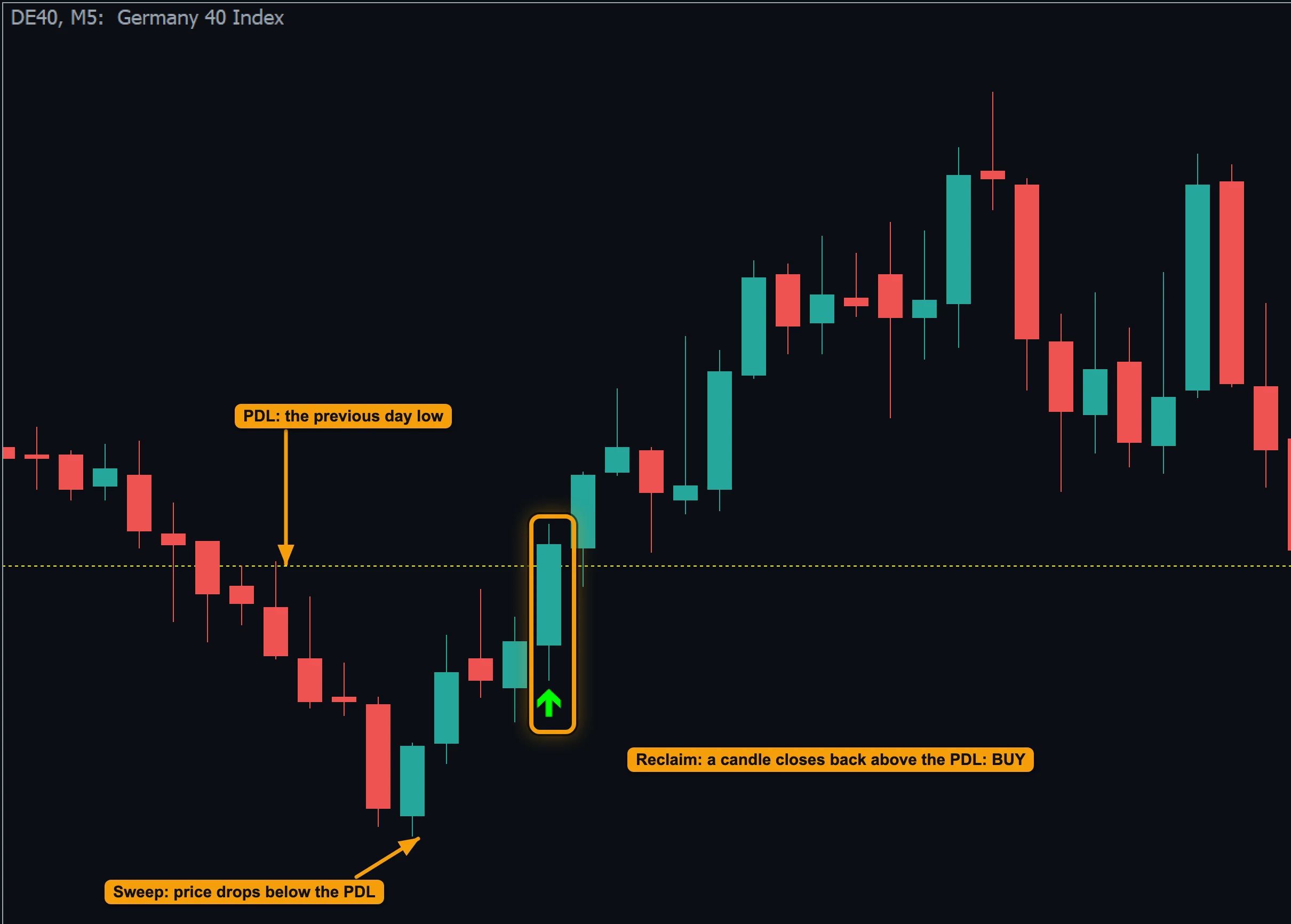
- The PDL, the previous day low (dotted line).
- Sweep: price drops below the PDL and the level is armed.
- Reclaim: a candle closes back above the PDL: BUY. Price then rose about 65 points.
A level that is swept but not reclaimed within Reclaim Timeout - all Reclaim Triggers is disarmed (a swing is removed). The offsets are in Reclaim Settings.
IFVG
After the sweep, instead of waiting for a close back across the level, FCC_EA waits for an inverted fair value gap in the reversal direction: a gap left by the move into the sweep that price then closes back through. It enters on the close of that candle or on the retest of the gap (IFVG Entry Mode). See FVG / IFVG Settings.
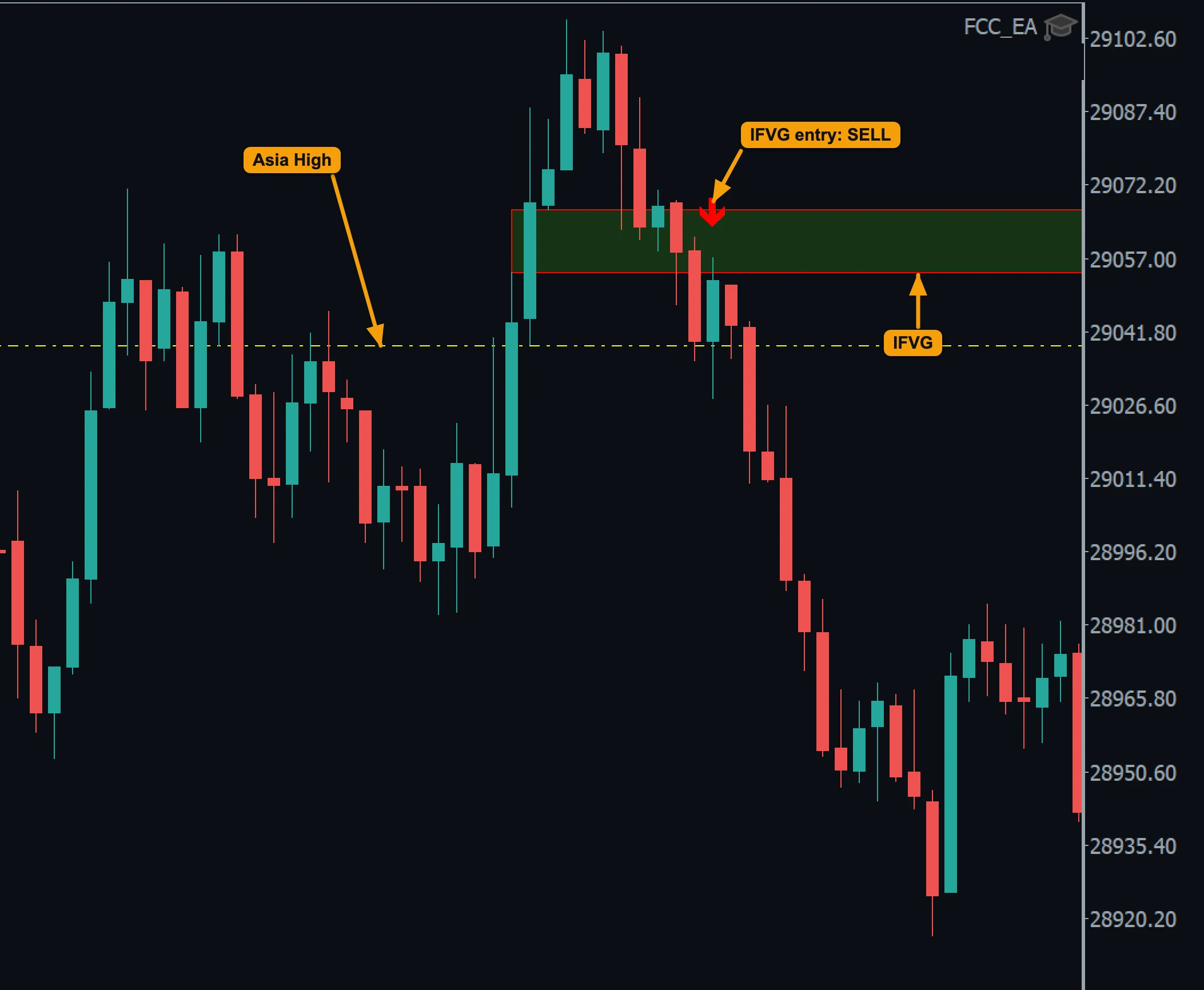
- The Asia High (yellow line); price sweeps above it.
- The IFVG box drawn by FCC_EA: the gap of the push, inverted by a close below it.
- IFVG entry: price retests the box and FCC_EA sells. The sweep high holds and price then fell more than 200 points.
Touch
No sweep needed: the trade opens the moment price touches the level from its normal side (a high from below, a low from above). Each contact fires once; price has to move away and come back for the next one.
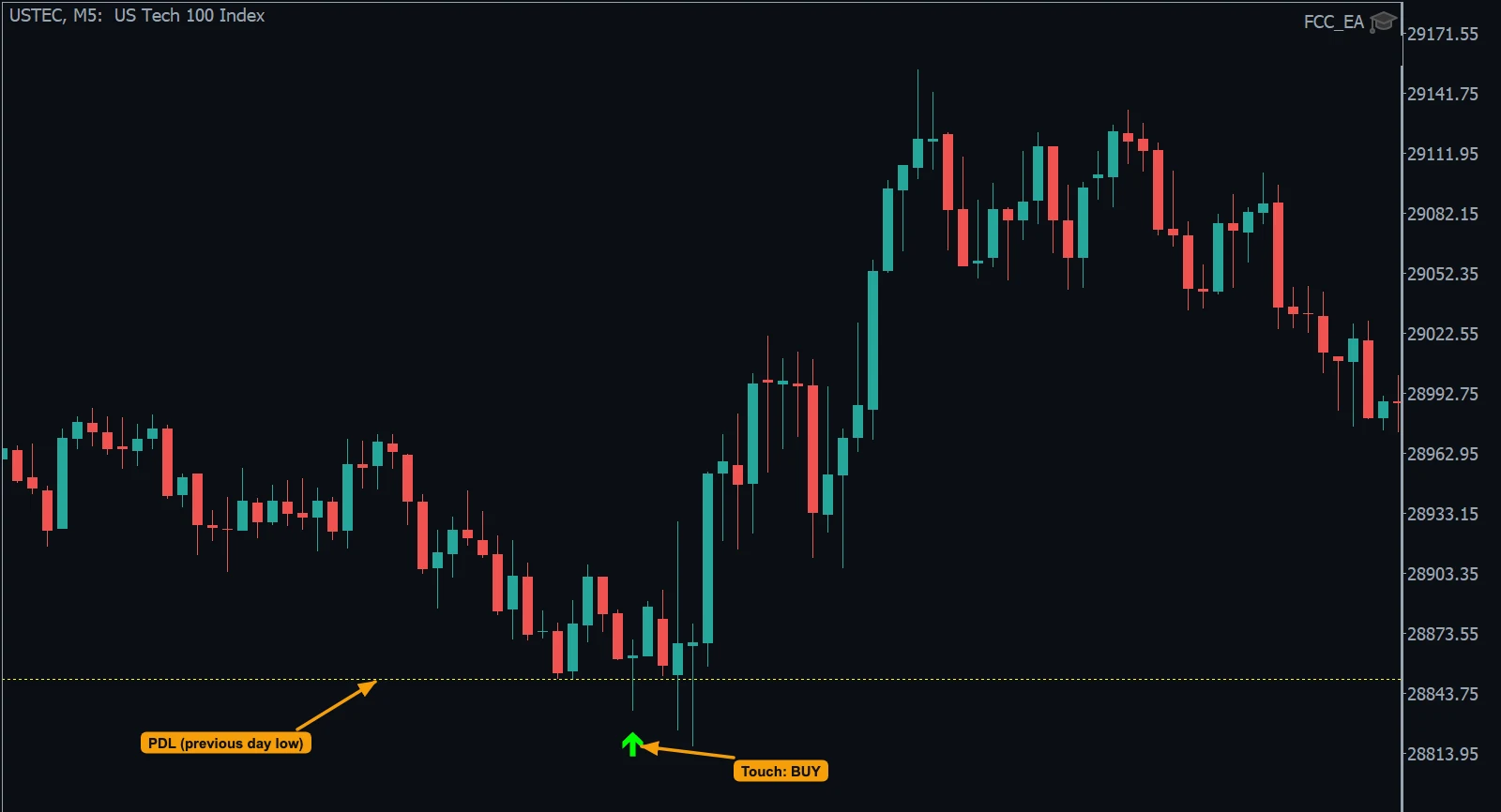
- The PDL, the previous day low (dotted line).
- Touch: price reaches the PDL from above: BUY. Price then rose about 290 points.
Open-hour levels: both directions
An open-hour level has no fixed side. FCC_EA looks at where the last Open-Hour: Closed Bars to Set / Flip Side candles closed: closes above it make it a support (BUY), closes below it a resistance (SELL), and it flips when enough candles close on the other side. Open-Hour Warm-Up keeps it quiet for a few minutes after the opening time.
Life of a level
- Used levels: after a trade a level turns grey (Used Level Color) and does not trade again; Max Trades per Level Before Removal allows more trades per level. Used levels are remembered when FCC_EA restarts.
- Rejection blocks and order blocks are retired by their RB: Retire Rule / OB: Retire Rule. A traded rejection block is removed; a traded order block stays grey until server midnight. Both are found again from the chart history when FCC_EA starts and at server midnight.
- Swings disappear when price trades through them and are rebuilt fresh every day at server midnight (Rebuild Swing Levels at Server Midnight?).
- Sessions, custom range and open-hour levels: with Keep until the next one starts, yesterday's level stays tradeable overnight until today's window replaces it; with Wipe all at server midnight they are cleared every night.
- Previous day / week change with each new day / week.
Extra confirmation
- Volume spike (Use Volume Spike Confirmation?): the signal candle's volume must be a multiple of the recent average.
- The global filters (trend, VWAP, pivot, maximum price distance) work as with any method.
Seeing the levels
Display Level Lines? and Display Level Labels? draw every level with its name (PDH, Asia L, OH …). Hover over a line to see its name, price, direction, state (armed, used) and number of trades.
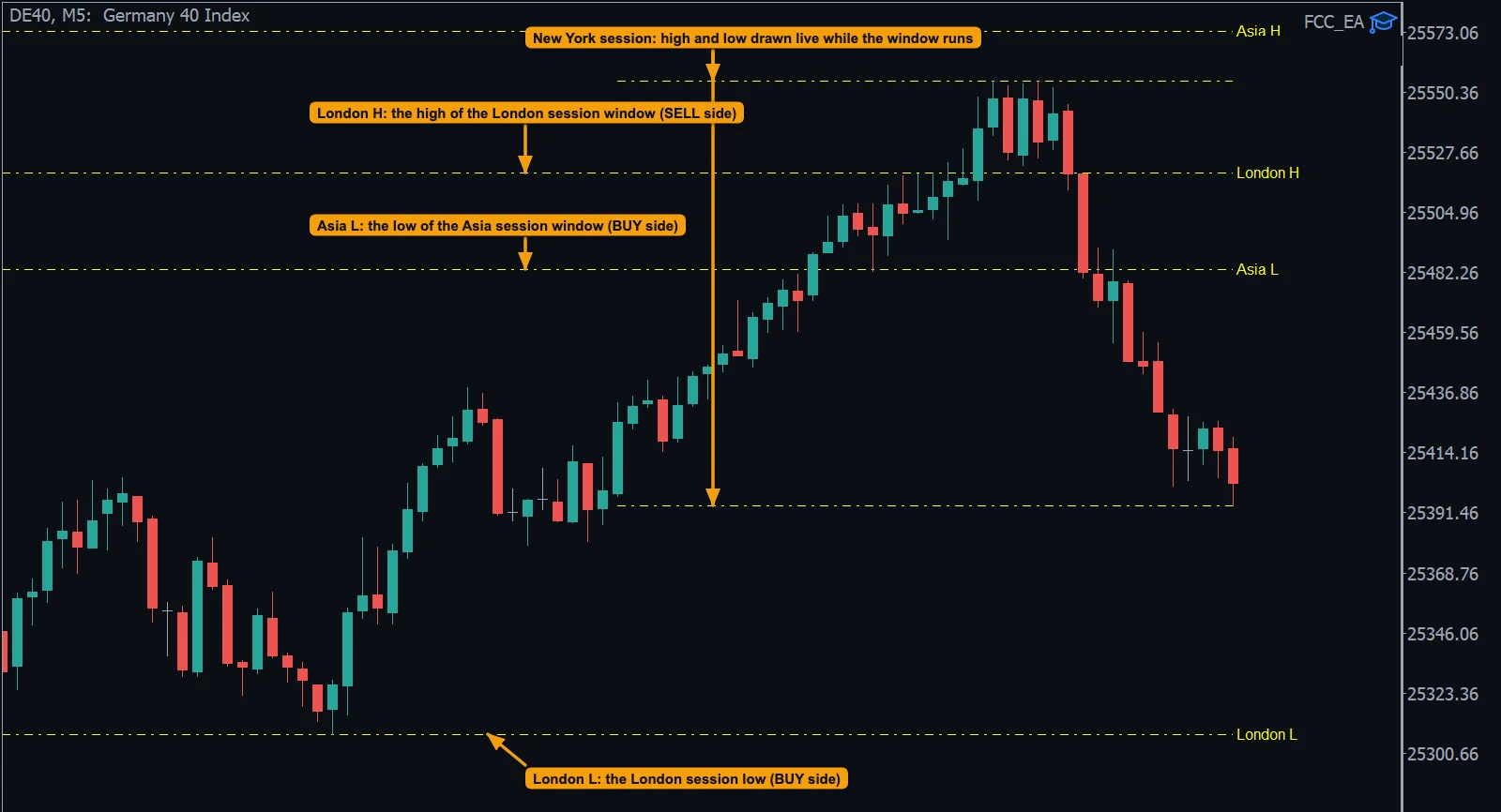
- London H: the high of the London session window. A high level gives SELL signals.
- Asia L: the low of the Asia session window. A low level gives BUY signals.
- London L: the low of the London session window.
- New York session: its high and low are drawn live while the window runs and become tradeable when it ends.
Use case: FCC_EA for ICT & Smart Money traders — liquidity, sweeps, FVG / IFVG, order blocks, rejection blocks and killzones on one page.
All settings for this feature Liquidity Sweep Signals settings → Reclaim settings → FVG / IFVG settings →
Backtest this setup free in the Strategy Tester, and adjust it whenever the market changes; every feature is in every plan. Backtest results depend on your broker's data and don't guarantee future results.
Check the FAQ or write to us. We reply within one business day.